


Homeowners insurance is now one of the biggest lines in a Texas house payment. It is also the line most buyers shop last, usually a few days before closing.
There is a second problem this month. The federal flood insurance program is only authorized through December 11, 2026. So I pulled the state and federal numbers into one place. Here is what coverage costs, what it leaves out, and what to do before that date.
Key Takeaways
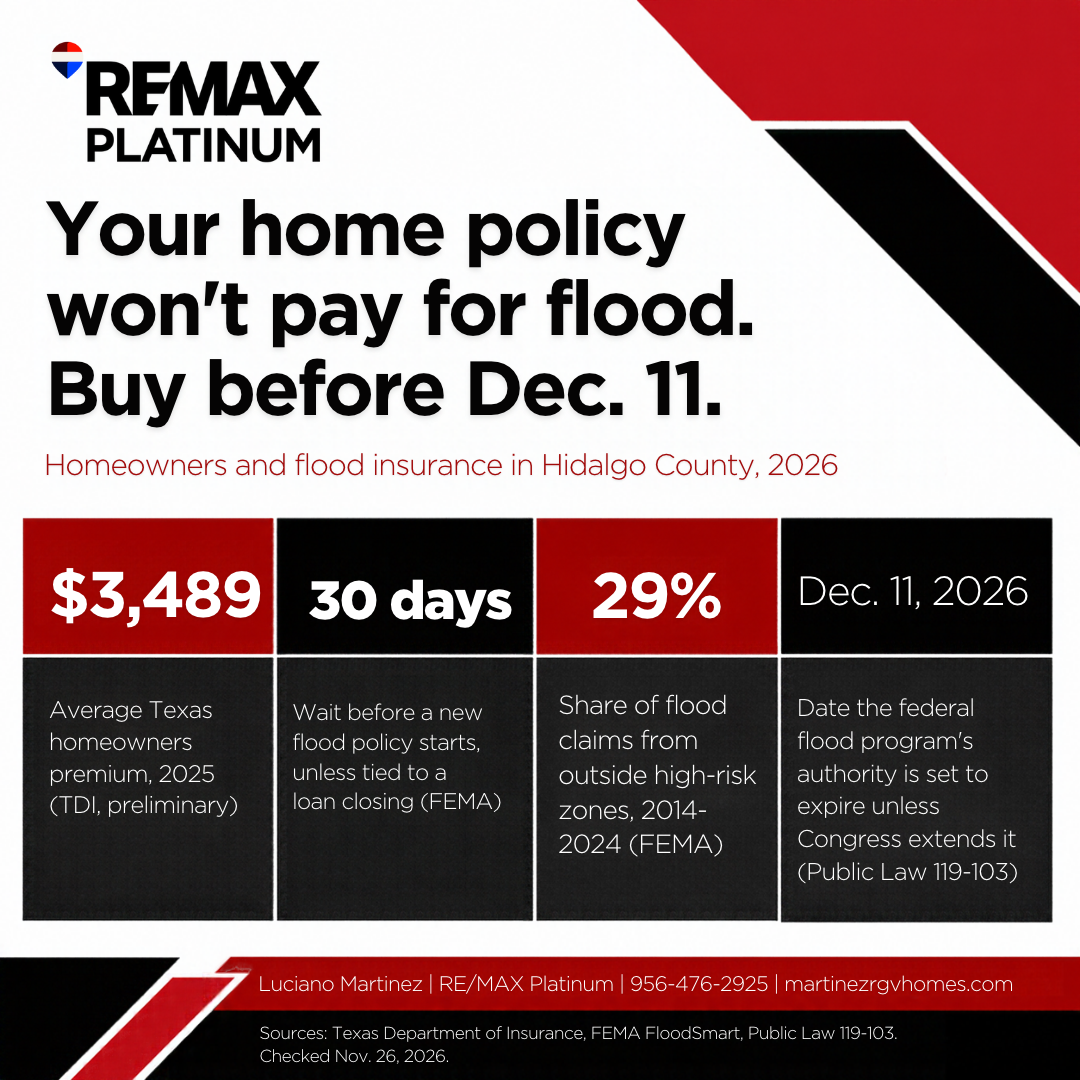
- Premiums nearly doubled: the average Texas homeowners premium went from $1,961 in 2019 to $3,489 in 2025, based on preliminary state data.
- Flood is a separate policy: most homeowners policies do not cover flood damage, in any flood zone.
- New flood policies wait 30 days: the exception is a policy bought with a new or refinanced mortgage.
- December 11 matters: if Congress does not extend the National Flood Insurance Program, it cannot sell new or renewal policies until it does.
- Low-risk is not no-risk: 29% of flood claims from 2014 to 2024 came from outside high-risk zones.
Does homeowners insurance cover flooding in the Rio Grande Valley?
In most cases, no. A standard Texas homeowners policy covers wind, hail, fire, and many kinds of water damage, like a burst pipe. It generally does not cover rising water that comes in from outside. For that, you need a separate flood policy, from the National Flood Insurance Program (NFIP) or a private insurer. Read your own policy's water exclusions to be sure.
What homeowners insurance costs in Texas now
The Texas Department of Insurance (TDI) publishes the average homeowners premium every year. Here is how it has moved:
| Year | Average Texas homeowners premium | Average rate change |
|---|---|---|
| 2019 | $1,961 | 4.2% |
| 2021 | $2,124 | 5.9% |
| 2022 | $2,374 | 10.8% |
| 2023 | $2,795 | 21.1% |
| 2024 | $3,291 | 18.7% |
| 2025 (preliminary) | $3,489 | 4.3% |
That 2025 average works out to about $291 a month. Part of the jump is bigger coverage. The average amount insured rose to $432,800 in 2025.
The Dallas Fed looked at it another way in April. The median Texas homeowner paid 60% more for insurance in 2024 than in 2019. Nationally, the increase was 30%.
Texas A&M's Real Estate Research Center put it per dollar of home value. In 2024, Texans paid about $540 a year for every $100,000 of value. The national figure was about $340.
These are statewide numbers. TDI also has a county map with average premiums for every Texas county. I could not pull the Hidalgo County figure for this post, so check the map on tdi.texas.gov for your county.
The good news: rates are leveling off
The big increases were 2023 and 2024. In 2025, the average rate change dropped to 4.3%.
In October, TDI said most homeowners rate changes filed since July 1 were decreases. They affected about 700,000 policyholders. Filings over the prior 90 days averaged a 4.3% decrease.
That does not mean your renewal will go down. It does mean this is a good year to get quotes instead of auto-renewing.
Wind and hail: the deductible most people miss
Wind and hail are the big ones in Texas. TDI says they averaged 62% of homeowners losses since 2019.
Many policies use a separate deductible for them, set as a percentage. TDI says a common setup is 2% for wind or hail and 1% for other damage.
A percentage deductible is usually based on your dwelling coverage, not the damage. On a home insured for $300,000, a 2% deductible means you pay the first $6,000 of a hail claim. Ask your agent how yours is figured, and whether a lower one is worth the extra premium.
One more Valley detail. The Texas Windstorm Insurance Association (TWIA) covers wind on parts of the coast, including Cameron and Willacy counties. Hidalgo County is not on its list. In McAllen, Mission, and Edinburg, wind coverage is normally part of the regular homeowners policy.
Flood insurance in Hidalgo County: why it matters here
The March 2025 storm is the best local example. The National Weather Service measured 9.13 inches of rain in McAllen from March 26 to 28. Weslaco got 8.60 inches. Parts of the Valley got close to 20 inches.
The weather service said at least a thousand buildings had water inside them. Several hundred people were rescued.
The state's damage survey tells the insurance story. Of 8,393 people who reported damage, about 1,500 said they were insured. About 3,700 said they were not.
How flood zones work
FEMA flood maps sort land into zones. High-risk areas start with A or V. Moderate and lower-risk areas are B, C, or X.
If a home is in a high-risk zone and you use a federally backed mortgage, your lender will require flood insurance. In an X zone, lenders usually leave it up to you.
FEMA's own numbers make the case for X zones too. From 2014 to 2024, 29% of NFIP claims came from outside high-risk areas. From 2020 to 2024, the average claim payment was $82,614.
You can look up any address on FEMA's Flood Map Service Center at msc.fema.gov. Ask the seller about past flooding too. Texas sellers have to answer flood questions on the disclosure.
What an NFIP policy covers
- Building: up to $250,000 for a single-family home.
- Contents: up to $100,000, bought as a separate coverage.
- Waiting period: 30 days from purchase, in most cases.
- No wait: when you buy it while making, increasing, extending, or renewing a mortgage.
The 30-day wait is the trap. You cannot buy a policy when a storm is in the forecast and expect it to pay. If you already own your home, buy it on a quiet week.
The December 11 deadline
Congress authorizes the NFIP in short extensions. The latest one came in Public Law 119-103, signed September 2, 2026. It moved the end date from September 30 to December 11, 2026.
This has happened before. The program lapsed for about six weeks in fall 2025, during the federal shutdown.
Here is what a lapse means, based on the National Association of REALTORS and the Congressional Research Service:
- No new or renewal NFIP policies can be issued until Congress acts.
- Existing policies stay in force until they expire.
- Private flood insurance is not affected.
- Home sales can still close. A seller's NFIP policy can be assigned to the buyer, and private flood policies are still sold.
Congress may extend it again before the date. I am not predicting either way. But if your flood policy renews in December, renew it early if your agent can.
Flood insurance is cheapest to buy before you need it and impossible to use if you bought it last week.
How insurance changes your house payment
Most RGV buyers pay insurance through escrow. It sits in the monthly payment with principal, interest, and taxes.
At the 2025 state average of $3,489, insurance adds about $291 a month. Add an optional X-zone flood policy and the total goes up again. Taxes add more: my 2026 Hidalgo County property tax guide estimated about $416 a month on a $280,000 McAllen home.
So on a typical Valley house, taxes and insurance can add $700 a month or more on top of the loan. Some new subdivisions add a PID or HOA too. My guide to PIDs, MUDs, and HOAs covers those.
What to do if you are buying
- Look up the flood zone before you make an offer.
- Get at least two homeowners quotes during your option period, not after it.
- Ask each agent how the roof's age affects the quote.
- Ask for a flood quote even in an X zone. Then decide.
- Give your lender the real numbers, so your loan estimate matches.
My checklist for what to do after your offer is accepted shows where insurance fits in the timeline. When you are ready to look, start with McAllen homes for sale, Mission homes for sale, or Edinburg homes for sale.
What to do if you already own
- Read your declarations page. Find the dwelling amount and every deductible.
- Shop your policy before renewal. Rates are moving down for many companies this year.
- If you have no flood policy, price one now and remember the 30-day wait.
- If you have one through the NFIP, check the renewal date against December 11.
- Take photos or a video of each room and keep them off-site. It speeds up any claim.
Frequently Asked Questions
Do I need flood insurance if I am not in a flood zone?
Your lender will not require it in an X zone, but you may still want it. From 2014 to 2024, 29% of NFIP claims came from outside high-risk areas. Get a quote and compare it with what one claim could cost you.
How long does flood insurance take to start?
An NFIP policy usually starts 30 days after you buy it. There is no wait if you buy it while getting, increasing, or refinancing a mortgage. Private flood policies set their own rules, so ask.
What happens if the flood insurance program expires on December 11?
The NFIP could not sell new or renewal policies until Congress extends it. Existing policies would stay in force until they expire. Private flood insurance would not be affected.
Is Hidalgo County covered by TWIA?
No. TWIA covers 14 coastal counties, including Cameron and Willacy, plus part of Harris County. Hidalgo County is not on that list, so wind coverage is normally in your regular homeowners policy.
How much is homeowners insurance in Texas?
TDI's preliminary average for 2025 is $3,489 a year, or about $291 a month. Your price depends on the home's value, roof, age, deductibles, and claims history. Get more than one quote.
Looking at a house and not sure what it will cost to insure? Call or text me at 956-476-2925 with the address. I will look up the flood zone with you and build the insurance quote into your option-period checklist. I am a REALTOR, not an insurance agent, so your agent and policy have the final word.
Sources: Texas Department of Insurance homeowners market overview (2025 preliminary data), TDI news releases (June 22 and October 8, 2026), TDI consumer column on homeowners changes (September 2024); Federal Reserve Bank of Dallas, Southwest Economy (April 15, 2026); Texas Real Estate Research Center, "Covered But Costly" (July 2026); TWIA coverage area; FEMA FloodSmart (flood risk and buying a policy); Texas Water Development Board NFIP page; Public Law 119-103, section 139 (September 2, 2026); National Association of REALTORS NFIP FAQ; Congressional Research Service, via the Out of the Storm News tracker; National Weather Service Brownsville, March 26 to 28, 2025 flood report; Office of the Texas Governor, disaster request (April 17, 2025). Tax estimate: 1,163 MLS sales in Edinburg, McAllen, Mission, and Alton, April 20 to October 16, 2026. Checked November 26, 2026. Not insurance advice.