Your offer got accepted. Congratulations, that's a real milestone. Now comes the part nobody warns you about: the stretch between "we got it" and "here are your keys." In Texas that window usually runs 30 to 45 days, and what you do in the first week of it matters more than almost anything else.
I've watched buyers coast through the first ten days thinking the hard part was over, then scramble at the end because an inspection came back late or the lender was still waiting on a pay stub. It doesn't have to go that way. Here's exactly what happens after your offer is accepted, in the order it happens, and what I push my buyers to do the moment we go under contract.
Key Takeaways
- Move fast in the first 48 hours: deliver your earnest money and option fee, and get the inspection scheduled immediately.
- The option period is your safety net: in Texas this is a short window where you can walk away for any reason and only lose the option fee.
- Order the inspection early, not late: you want the report in hand with days to spare so you have time to negotiate repairs before the option period ends.
- Send your lender every document the day they ask: financing delays are the number one reason closings get pushed.
- Expect 30 to 45 days: from accepted offer to closing table is the normal timeline in Texas.
What happens after the seller accepts your offer?
Once the seller signs, you're under contract. That means the home comes off the active market and a clock starts. Over the next several weeks you'll deliver your earnest money, complete an inspection, work through your option period, get the home appraised, finish your loan approval, review the title, and do a final walk-through before closing.
Here's the order it happens in Texas:
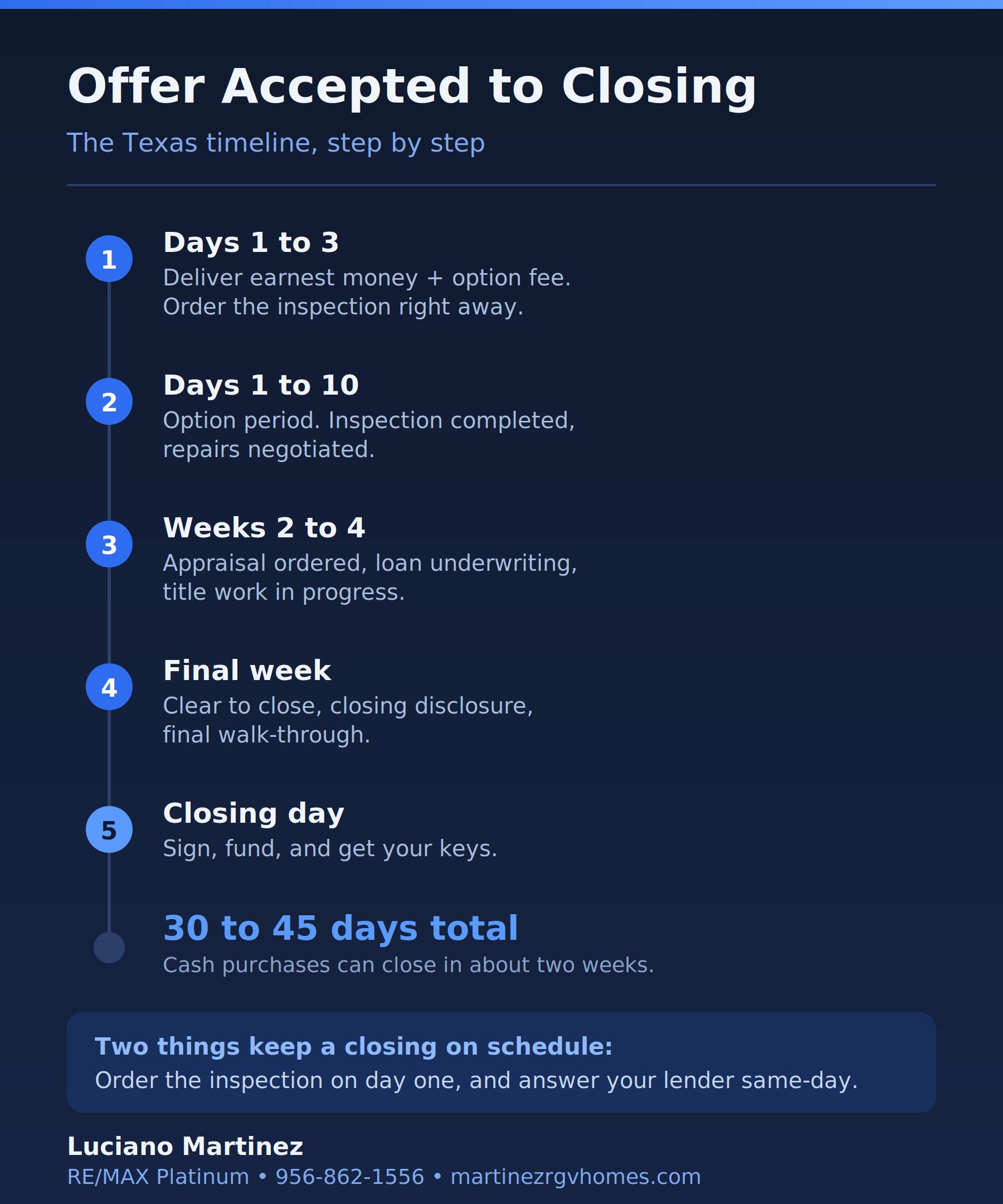
- Days 1 to 3: deliver earnest money and option fee, order the inspection
- Days 1 to 10: option period, inspection completed, repair negotiations
- Weeks 2 to 4: appraisal, loan underwriting, title work
- Final week: clear to close, final walk-through, closing day
Step 1: Deliver your earnest money and option fee
These are two separate payments and buyers mix them up all the time. Earnest money is your good-faith deposit showing you're serious. It sits with the title company and gets applied to your costs at closing. The option fee is a smaller, separate payment that buys you the right to back out during the option period.
Both have hard deadlines written into your contract, usually within three days of the effective date. Miss them and you can put your contract at risk, so this is not the week to be slow. Your agent will tell you exactly where to deliver each one.
Step 2: Order the inspection immediately, not eventually
This is the single biggest thing I push on the day we go under contract, and it's where I see buyers lose the most ground.
The moment we're under contract, I start walking my buyers through inspections and we get one scheduled as soon as possible. The reason is simple: you want that report in your hands well before the option period ends, not on the last day. If the inspector finds something, you need time to get repair bids, talk it over, and actually negotiate with the seller. A report that lands the afternoon your option period expires gives you no room to do anything but accept it or walk.
When you order the inspection on day one instead of day five, you turn a rushed decision into an informed one. That's the whole game in this stage.
Depending on the home, you may also want specialists: a foundation engineer, a pool inspector, a roofer, or a termite inspection. Order those early too, since they book out.
Step 3: Understand your option period in Texas
The option period is one of the best protections Texas buyers have, and a lot of people don't fully understand it.
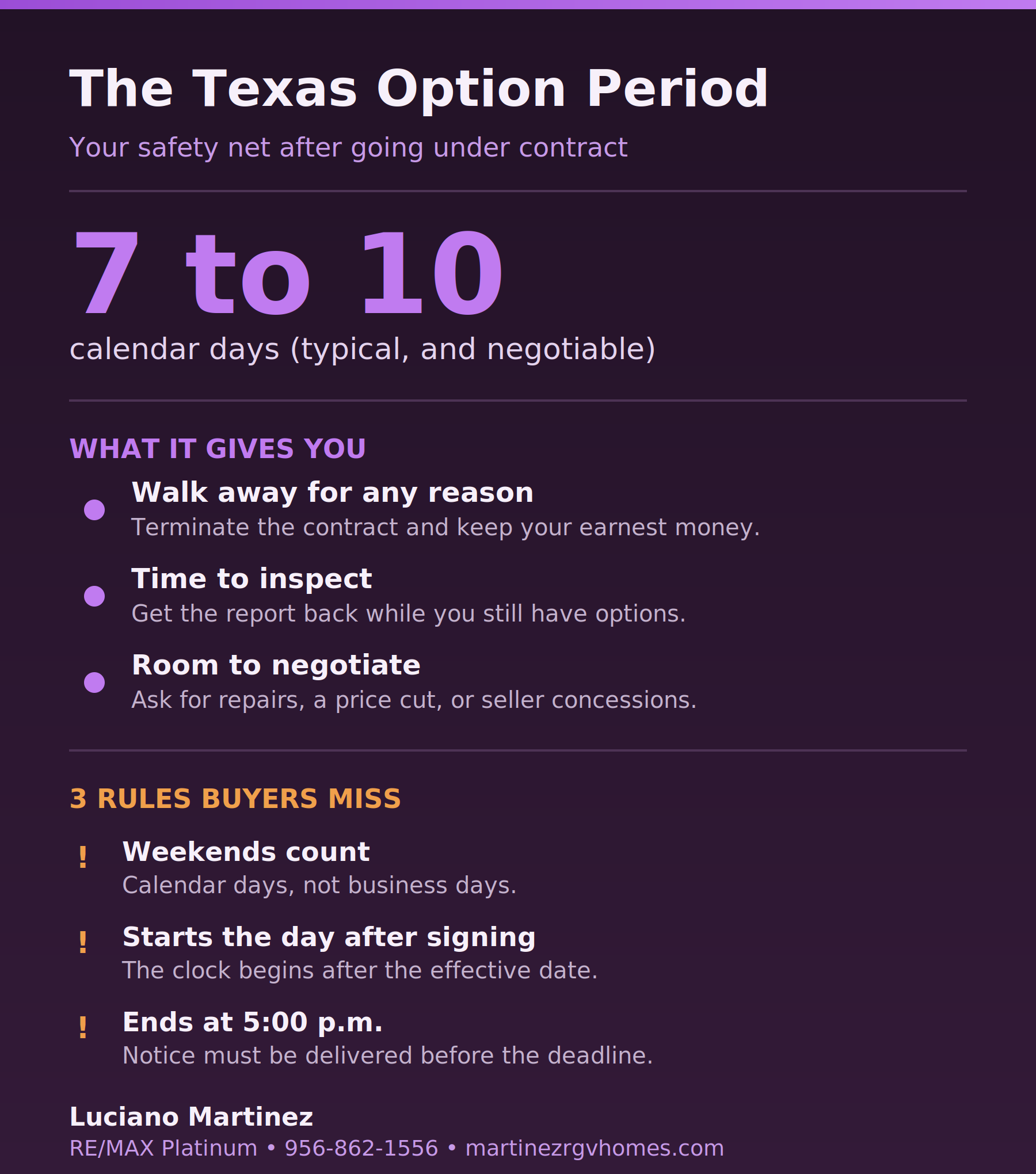
For a negotiated fee, you get a set number of days where you can terminate the contract for any reason at all and get your earnest money back. You lose only the option fee. It's typically 7 to 10 days, though the length and the fee are both negotiable and get written into your contract.
A few things buyers ask me constantly:
It includes weekends. The option period runs on calendar days, not business days, so a 7-day option period that starts Friday is burning through your weekend whether you like it or not.
It starts the day after the effective date. The effective date is when the last party signs and the contract is fully executed, and the clock starts the next day.
It ends at a specific time. Usually 5:00 p.m. on the final day. If you're going to terminate, notice has to be delivered before that deadline, not the next morning.
This window is where your inspection findings turn into leverage. If the inspection turns up real problems, this is when you go back to the seller and ask for repairs, a price reduction, or seller concessions to cover your closing costs. I work through those options with my buyers based on what the report actually shows and what the home is worth. And if the seller won't budge and the issues are serious, the option period is your clean exit.
Step 4: Stay ahead of your lender
Here's the other thing I start pushing from day one: turn in every document your lender asks for, the day they ask for it.
It sounds small. It isn't. Financing delays are the most common reason closings get pushed back, and almost all of them trace to paperwork sitting in someone's inbox. Your lender will ask for pay stubs, bank statements, tax returns, letters of explanation, updated documents when something changes. Every day one of those sits unanswered is a day added to your timeline.
Two habits that keep you on schedule. First, respond same-day, even if it's just to say the document is coming. Second, don't make any financial moves while you're under contract. No new credit cards, no financing a car, no big deposits you can't explain, no changing jobs if you can avoid it. Underwriters recheck your credit and your accounts before closing, and a surprise there can undo the whole loan.
Step 5: Appraisal, title, and the final stretch
While your loan is in underwriting, two other things run in the background.
The appraisal is ordered by your lender to confirm the home is worth what you're paying. If it appraises at or above your price, you're fine. If it comes in low, you and the seller have to work it out, which might mean renegotiating the price, you covering the difference in cash, or in some cases walking away depending on how your contract is written.
The title company researches the property's ownership history to make sure the seller can actually convey clear title, and checks for liens or claims. Read your title commitment when it arrives instead of skimming it.
Near the end you'll get your closing disclosure, which lays out your final numbers. You'll also do a final walk-through, usually the day before or the morning of closing, to confirm the home is in the condition you agreed to and any negotiated repairs actually got done. Then you sign, fund, and the home is yours.
How long does it take from offer to closing?
Most Texas transactions close in 30 to 45 days from accepted offer. A cash purchase can move faster, sometimes in two weeks, because there's no loan underwriting or appraisal to wait on. Financed purchases follow the lender's pace.
What stretches a timeline: slow document turnaround from the buyer, a low appraisal that needs renegotiating, title issues, or repair negotiations that drag. What keeps it tight: ordering your inspection immediately, answering your lender the same day, and staying reachable. Almost everything within your control comes down to speed on those two fronts.
Frequently Asked Questions
What happens after the seller accepts your offer?
You go under contract and the home comes off the market. Within the first few days you deliver your earnest money and option fee and schedule your inspection. Then comes your option period, inspection and repair negotiations, the appraisal, loan underwriting, title work, a final walk-through, and closing. In Texas the whole process usually takes 30 to 45 days.
How long is the option period in Texas?
It's negotiable and written into your contract, but most option periods run 7 to 10 days. Both the length and the option fee are agreed on between you and the seller when the contract is signed, so it can be shorter or longer depending on what you negotiate.
Does the option period include weekends?
Yes. The Texas option period is counted in calendar days, not business days, so weekends and holidays all count toward your total. A 7-day option period starting on a Friday gives you the same 7 days as one starting on a Monday.
Can a buyer back out after the option period in Texas?
Once the option period expires, backing out gets much harder and you risk losing your earnest money. You may still have protection through other contract contingencies, like financing or appraisal, depending on how your contract is written. But the option period is the only window where you can terminate for any reason at all and get your earnest money back. That's why using it well matters so much.
When does the option period start in Texas?
It begins the day after the effective date of the contract, which is when the last party signs and the contract is fully executed. It typically ends at 5:00 p.m. on the final day, so any termination notice has to be delivered before that deadline.
What's the difference between earnest money and the option fee?
Earnest money is your good-faith deposit held by the title company and applied toward your costs at closing. The option fee is a separate, smaller payment that buys your right to terminate during the option period. If you back out during that window, you get your earnest money back but the option fee stays with the seller.
If you just went under contract in McAllen, Mission, Edinburg, or anywhere in the Rio Grande Valley and you're not sure what happens next, I'm glad to walk you through it. Getting the inspection ordered early and staying ahead of your lender are the two things that keep a closing on schedule, and I stay on top of both for my buyers. Reach me at 956-862-1556.