


There's a particular kind of phone call I hate making. It's the one where I have to tell a buyer that the home they've already mentally moved into isn't going to work out. I've made that call for a low appraisal, for an inspection that turned up more than anyone expected, and for financing that fell apart after the buyer was already approved.
It doesn't happen often, but it happens more than most people think, and it's happening more now than it did a few years ago. The good news is that most of the reasons deals collapse are predictable, and several of them are preventable if you know what to watch for.
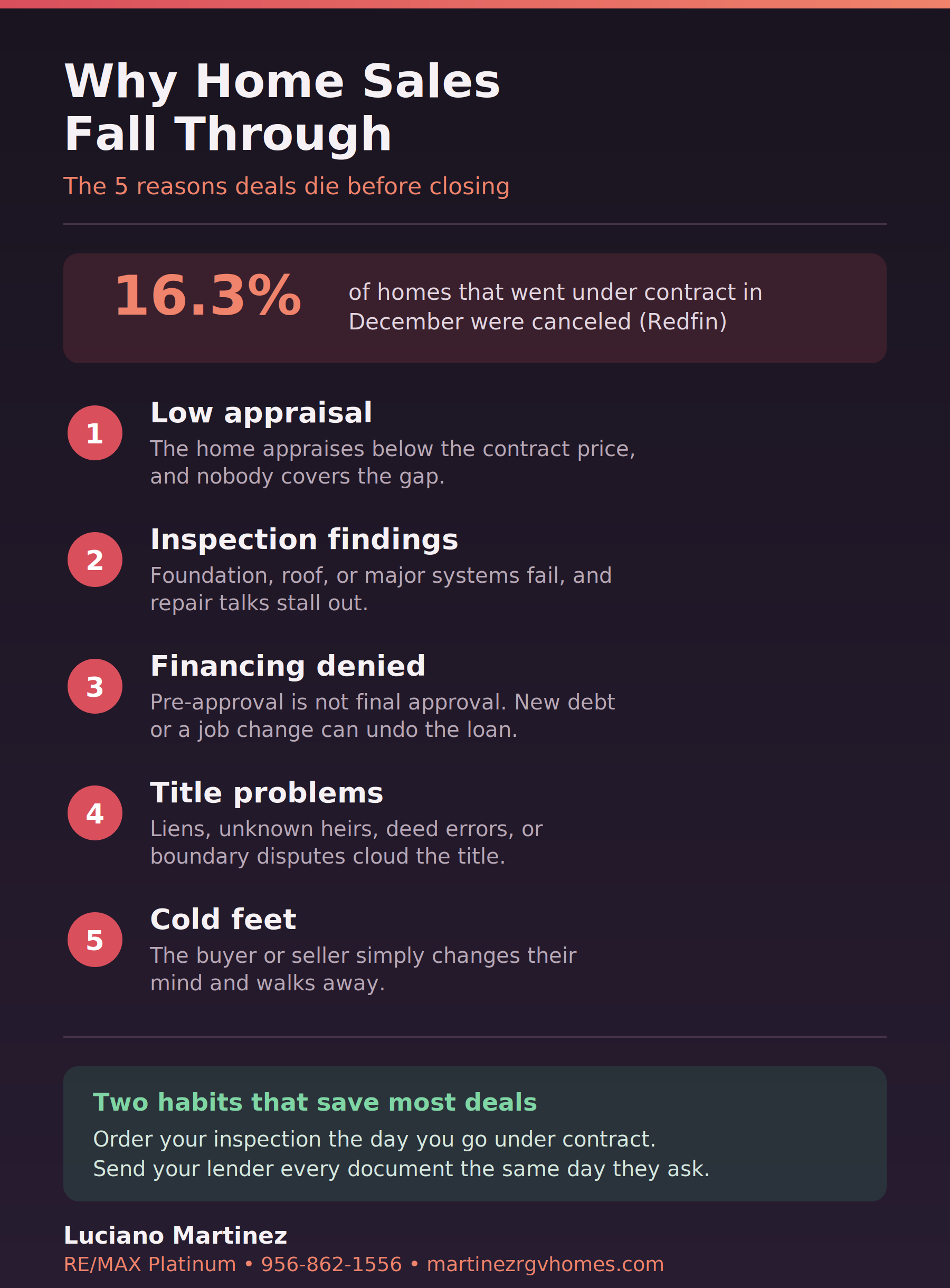
Here's how often home sales actually fall through, the five reasons it happens, and what you can do about each one.
Key Takeaways
- Cancellations are at record levels: Redfin reported that 16.3% of homes that went under contract in December were canceled, the highest share since it began tracking in 2017.
- The estimates vary a lot: NAR's methodology puts the rate closer to 6%, so the honest answer is somewhere in that range depending on how you count.
- Buyer's markets produce more cancellations: when buyers have options and leverage, they walk away more often. The RGV is currently at 9.2 months of inventory.
- The five usual culprits: low appraisal, inspection findings, financing denial, title problems, and plain cold feet.
- Most are survivable: a deal that hits a snag doesn't automatically die. Many get renegotiated instead.
How often do home sales fall through?
It depends on who's counting, and the two main sources disagree meaningfully.
According to Redfin, roughly 40,000 signed purchase agreements were canceled in December, about 16.3% of all homes that went under contract. That was the highest share since the company started tracking the number in 2017, up from 14.9% a year earlier. The National Association of REALTORS®, which measures it differently, has reported a cancellation rate closer to 6%.
So the honest answer is that somewhere between roughly 1 in 16 and 1 in 6 contracts don't make it to closing, depending on the methodology. Either way, the trend is pointing up.
Texas shows up in that data too. Among the largest metros Redfin tracked, San Antonio had one of the highest cancellation rates in the country at 20.6%.
Reason 1: The appraisal comes in low
Your lender orders an appraisal to confirm the home is worth what you agreed to pay. When it comes back below your contract price, the lender will only finance based on the appraised value, not your offer. That gap has to come from somewhere.
Say you're under contract at $290,000 and the appraisal comes in at $275,000. That's a $15,000 hole. You have a few options:
- The seller reduces the price to the appraised value
- You cover the difference in cash on top of your down payment
- You split it somewhere in the middle
- You dispute the appraisal, which sometimes works if the appraiser missed relevant comparable sales
- You walk away, if your contract protects you
I've had this one kill a deal. It usually dies when the seller refuses to come down and the buyer doesn't have the extra cash sitting around. But it doesn't have to be fatal. In a market with this much inventory, sellers who understand their position often do come down, because their next buyer will probably run into the same appraisal.
Reason 2: The inspection turns up serious problems
This is the most common deal-killer I see, and it's also the one that's most often survivable.
Every used home has issues. A good inspection report on a 20-year-old house will list dozens of items, and most of them are minor. What ends deals is the short list of expensive structural problems: foundation movement, a roof at the end of its life, major electrical or plumbing failures, extensive water damage, or an active pest infestation.
The reason inspections end deals isn't usually the repair itself. It's the negotiation that follows. The buyer asks for repairs or a price reduction, the seller refuses or offers far less than the cost, and neither side moves. That's when a deal dies over something that could have been solved.
This is exactly why I get inspections ordered the day we go under contract. If the report comes back with days left in your option period, you have time to get repair bids and negotiate from a position of knowledge. If it lands the afternoon your option period expires, your only choices are to accept it blind or walk.
Reason 3: The buyer's financing gets denied
This one blindsides people, because they were already pre-approved. Here's the thing: pre-approval is not final approval. Your loan goes through underwriting after you're under contract, and underwriters recheck everything before closing.
Deals die here when something changes between pre-approval and closing:
- The buyer opens a new credit card or finances a car or furniture
- A large unexplained deposit lands in their bank account
- They change jobs or their income changes
- Their credit score drops
- Requested documents don't get turned in and the loan stalls past the deadline
I've watched financing fall apart on deals that should have closed. The frustrating part is that it's the most preventable item on this list. Don't buy a car, don't open new credit, don't move large sums of money around, and send your lender every document the same day they ask for it. That's genuinely most of it.
Reason 4: Title problems
Before you can close, the title company researches the property's ownership history to confirm the seller can actually convey clear title. Sometimes that search turns up something.
Common title issues include unpaid liens from contractors or taxes, an unknown heir with a claim on the property, an error in a prior deed, a boundary or survey dispute, or an easement nobody disclosed. In an area like ours with a lot of family land passed down through generations, inherited property with unclear ownership shows up more than you'd expect.
Most title issues get resolved. The title company works through them, and that's a large part of what you're paying for. But some take months, and some can't be cleared at all, which ends the deal.
Reason 5: The buyer or seller changes their mind
Sometimes there's no technical problem. Someone just backs out.
Buyers get cold feet when they run the monthly payment again and it feels heavier than it did during the excitement of the offer. Sellers back out when a job relocation falls through, when their next home purchase collapses, or when they simply decide they don't want to move.
In Texas, the buyer's clean exit is the option period. During that window you can terminate for any reason at all and get your earnest money back, losing only the option fee. Once the option period ends, walking away gets much more expensive.
Sellers have far less room. A seller who backs out after the option period without a contractual reason can face real legal consequences, since the buyer may be able to sue for damages or to force the sale.
Why more deals are falling apart right now
The rise in cancellations isn't random. It tracks with inventory.
Redfin's data showed Atlanta leading the nation in cancellations at 22.5% after the metro shifted rapidly into a buyer's market, with sellers outnumbering buyers by a wide margin. That's the pattern: when buyers have leverage and lots of choices, they're willing to walk away over problems they would have absorbed in a competitive market.
The Rio Grande Valley is in that same position. We're carrying about 9.2 months of inventory across the McAllen-Edinburg-Mission area, well above the six months that marks a balanced market. Buyers here have options, and buyers with options are more selective once they're under contract.
That cuts both ways. If you're buying, it means you don't have to accept a home with serious problems just because you're already in contract. If you're selling, it means you can't count on a buyer to overlook things, and it's worth addressing known issues before you list.
How to keep your deal from falling apart
For buyers, most of it comes down to two habits. Order your inspection immediately so you have time to act on what it finds. And keep your financial life boring until you have keys: no new credit, no big purchases, no unexplained deposits, and same-day responses to every lender request.
For sellers, price realistically so the appraisal supports the contract, and consider a pre-listing inspection so you learn about the foundation problem before a buyer's inspector does. Fixing an issue on your own schedule always costs less than renegotiating under pressure.
And for both sides: most problems are negotiable. A deal that hits a snag isn't automatically dead. It usually dies when one party digs in and refuses to move at all. The ones that close are the ones where people stay at the table.
Frequently Asked Questions
How often do home sales fall through?
Estimates vary by source. Redfin reported that 16.3% of homes that went under contract in December were canceled, the highest share since it began tracking in 2017. The National Association of REALTORS®, using a different methodology, has reported a rate closer to 6%. Either way, cancellations have been rising.
Can I back out of buying a house after the inspection?
In Texas, yes, if you're still within your option period. That window lets you terminate the contract for any reason and get your earnest money back, losing only the option fee. Once the option period expires, backing out becomes much harder and you risk losing your earnest money.
What happens if the appraisal comes in low?
Your lender will only finance based on the appraised value, so the gap between that and your contract price has to be resolved. Options include the seller lowering the price, you paying the difference in cash, splitting it, disputing the appraisal, or terminating if your contract allows. A low appraisal doesn't automatically end a deal, but it does force a renegotiation.
Can financing be denied after pre-approval?
Yes. Pre-approval is not final approval. Your loan still has to clear underwriting, and lenders recheck your credit, income, and bank accounts before closing. New debt, a job change, large unexplained deposits, or missing paperwork can all cause a denial after you're already under contract.
What are the most common title issues when buying a house?
The most common are unpaid liens for taxes or contractor work, unknown heirs with a claim to the property, errors in previous deeds, boundary or survey disputes, and undisclosed easements. Most get resolved by the title company before closing, though some take months and a few can't be cleared.
Do I get my earnest money back if the sale falls through?
It depends on why and when. If you terminate during your option period, you get your earnest money back and lose only the option fee. If a contract contingency such as financing or appraisal protects you, you may also recover it. If you back out after the option period without a contractual reason, you likely lose it.
If you're under contract in McAllen, Mission, or Edinburg and something has come up, it's usually more fixable than it feels in the moment. I've worked through low appraisals, hard inspection reports, and financing problems, and most of them end at the closing table rather than in a dead deal. Reach me at 956-476-2925 and we'll figure out your options.
Keep reading