


Buying a luxury home is not just a bigger version of buying a regular house. The financing works differently, the inventory hides in places the public sites never show you, and the negotiation math at this level rewards patience in a way most buyers don't expect. I pulled the last 12 months of luxury sales across the McAllen area to write this, so everything here is built on real numbers from our market, not generic advice copied from a national blog.
If you're looking at homes in the $950,000-and-up range in McAllen, Mission, or Edinburg, here are the five things I'd want you to understand before you write a single offer.
Key Takeaways
- It's a deep buyer's market at the top: McAllen-area luxury homes are sitting at roughly 31 months of supply, so you have time and leverage on your side.
- Sellers are taking less than they ask: over the last year, luxury homes here closed at about 89% of list price on average.
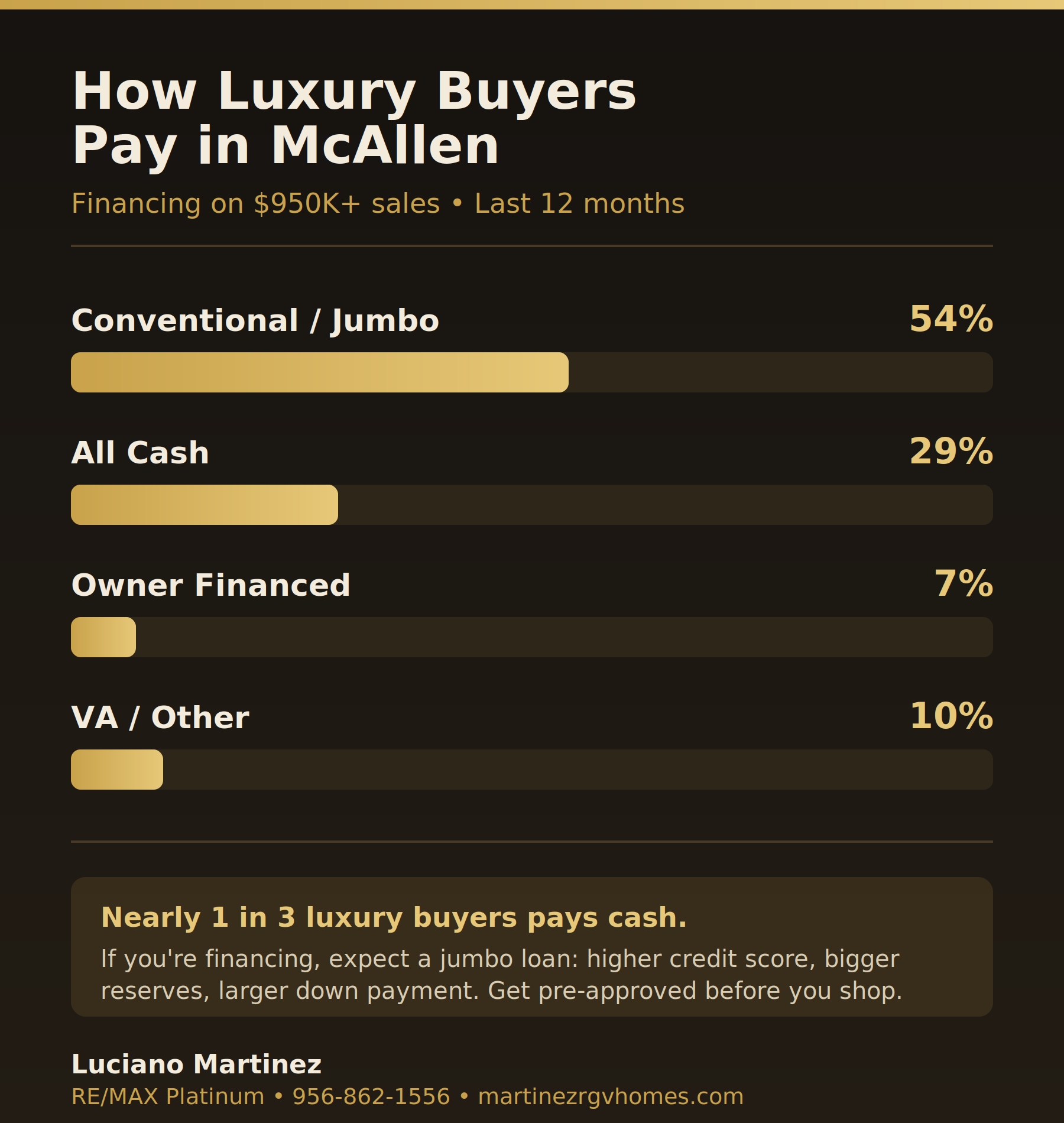
- Financing is its own world: anything over the conforming loan limit becomes a jumbo loan, with stricter rules. Nearly 30% of luxury buyers here pay cash.
- The best homes are often never advertised: pocket listings and off-market deals are common at this price point, and you need an agent plugged into them.
- Due diligence takes longer: bigger homes mean more systems, more inspections, and a longer timeline. Median days on market is 70, and that's normal.
What counts as a luxury home in McAllen, TX?
Luxury is relative to the market you're in. In McAllen, the luxury tier starts around $950,000 and runs up past $2.9 million. Over the last 12 months, the median luxury home in this area sold for $1.25 million, and the average came in near $1.41 million. The ceiling was a roughly 15,000-square-foot estate in Mission that closed at $2.99 million, all cash.
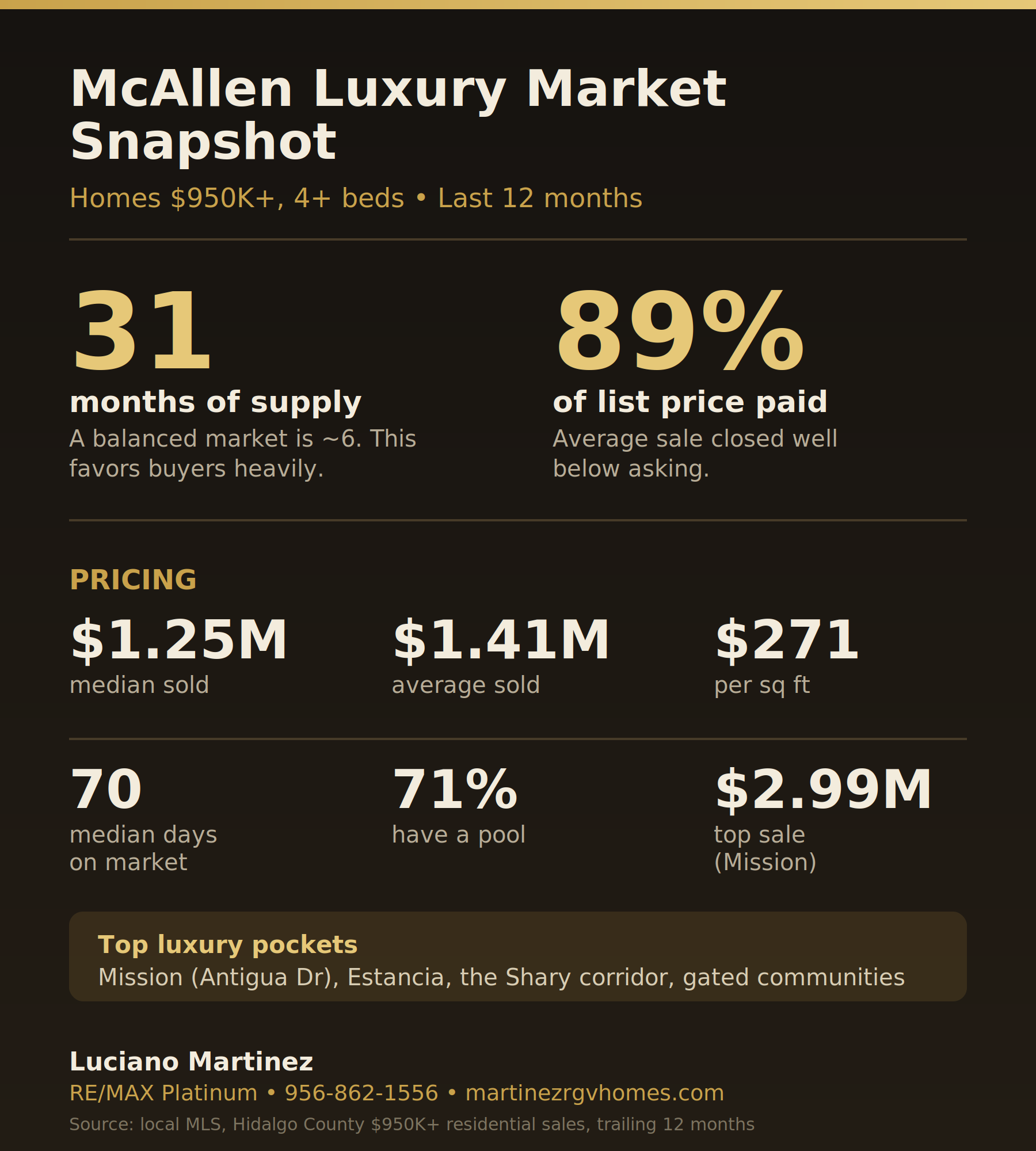
The real luxury pockets are concentrated. Mission carries some of the highest-end addresses in the Valley, with streets like Antigua Drive producing multiple multimillion-dollar sales. Estancia shows up again and again in the high-end data, and you'll find serious homes clustered along the Shary corridor and in newer gated developments. McAllen itself holds the most luxury inventory, followed closely by Mission and Edinburg.
One number worth knowing: luxury homes here average about $271 per square foot, and roughly 7 in 10 have a pool. At this level a pool is closer to expected than optional, so factor that into both your search and your resale thinking.
You can see the current high-end inventory for yourself here: luxury homes for sale in Hidalgo County ($950K+, 4+ beds).
Must-know #1: You're buying in a deep buyer's market
Here's the single most important thing the data shows. Over the last year, 28 luxury homes sold across the McAllen area while 72 sit on the market right now. That works out to roughly 31 months of supply. For comparison, a balanced market is around six months. The luxury end here is heavily tilted toward buyers.
What that means in practice: you are not in a bidding war. You have time to tour, time to think, and real room to negotiate. Of the 28 homes that sold, only 4 went for full asking price or above. The rest sold for less, and the average closing price landed at about 89% of the list price. On a $1.5 million listing, that 11% gap is $165,000 of negotiating room that buyers are actually capturing.
What I'd tell a buyer: don't anchor to the list price as if it's fixed. At this level it's a starting point, and the sold data gives you the leverage to make a confident, well-supported offer below it.
Must-know #2: Luxury financing means jumbo loans
Most luxury purchases cross the conforming loan limit, which puts you into jumbo loan territory. A jumbo loan is any mortgage larger than the limit set for conventional loans, and lenders treat them as higher risk. That means stricter requirements: a higher credit score, larger cash reserves, a bigger down payment, and more documentation of your income and assets.
The local data backs this up. Of the luxury homes that sold here, about 54% used conventional or jumbo financing and 29% were all cash. That cash share is high, and it matters even if you're financing, because when you compete against a cash buyer, you need your loan to be airtight. A strong pre-approval from a lender who actually does jumbo loans is not optional at this price point.
What I'd tell a buyer: talk to a lender before you fall in love with a house, and specifically ask whether they handle jumbo loans in-house. Get your proof of funds and pre-approval ready early. Sellers at this level want to see that you can close before they take their home off the market.
Must-know #3: The best homes are often off-market
At the luxury level, a lot of the best property never shows up on Zillow or the public portals. These are called pocket listings or off-market listings, and sellers use them for privacy, to quietly test a price, or because they don't want a parade of unqualified buyers walking through their home.
This is where a connected local agent earns their keep. If your entire search is limited to what's posted publicly, you're missing a real slice of the inventory. Agents who work this end of the market hear about homes before they list, and sometimes about homes that will never formally list at all.
What I'd tell a buyer: tell your agent exactly what you want, even the specific streets or developments, and let them work their network. In a market like ours where the high-end community is relatively small, those quiet connections turn up homes the public never sees.
Must-know #4: Due diligence is bigger and takes longer
A 7,000-square-foot home has more of everything: more roof, more HVAC systems, a pool and its equipment, sometimes a well or septic, irrigation, smart-home wiring, and acreage. Every one of those is something that can need repair, and every one deserves inspection. A standard home inspection is not enough here. You'll often want specialists for the pool, the foundation, the mechanical systems, and the roof.
This is part of why luxury homes take longer to close. Median days on market in our luxury data was 70 days, with an average of 92, and the timeline from contract to closing tends to run longer too. That's not a warning sign, it's the nature of the price point. The home that sold at the top of our market sat for 304 days before the right buyer came along.
What I'd tell a buyer: budget for a longer, more thorough process, and don't rush the inspections to save a week. At this price, the cost of a hidden foundation or roof problem dwarfs the cost of a few extra specialist reports.
Must-know #5: Think about resale before you buy
The luxury pool of buyers is smaller than the broader market, which cuts both ways. As a buyer today, that smaller pool is your advantage, it's why you have 31 months of supply and real negotiating power. But when you eventually sell, you'll be on the other side of that same equation.
So buy with resale in mind. Homes with broad appeal, a pool, good bones, and a location in a recognized luxury pocket like Mission's gated communities or the Estancia area tend to hold value and move faster when it's time to sell. Highly custom, one-of-a-kind features can be wonderful to live in but harder to sell, because the next luxury buyer has to share your specific taste.
What I'd tell a buyer: love the home, but don't ignore the fundamentals. Location, layout, and condition are what protect your investment in a thin luxury market.
Frequently Asked Questions
What do you need to know when buying a luxury home?
The biggest things are financing and inventory. Most luxury purchases require a jumbo loan, which means stronger credit, bigger reserves, and a larger down payment than a standard mortgage. You also need an agent connected to off-market listings, because many luxury homes never hit the public sites. And you should plan for a longer, more detailed due diligence process than a normal sale.
How much do you need to make to buy a million dollar home?
As a rough guide, lenders often want your home price to stay around three to four times your gross income, so a $1 million home typically suggests an income in the $250,000 to $300,000 range, depending on your down payment, debts, and the rate. Cash reserves matter just as much as income for jumbo loans. The real answer comes from a lender running your specific numbers, which is the first call I'd have any luxury buyer make.
Is it a good time to buy a luxury home in McAllen?
For buyers, the data says yes. The McAllen-area luxury market is carrying roughly 31 months of inventory and homes are closing at about 89% of list price on average. That combination of high supply and sellers accepting under-asking offers gives buyers unusual leverage right now.
What is a pocket listing?
A pocket listing is a home for sale that isn't publicly advertised on the MLS or sites like Zillow. The seller keeps it quiet, often for privacy, and only shares it through a private agent network. They're common in luxury real estate, which is why working with a well-connected local agent gives you access to homes other buyers never see.
Do you need a bigger down payment for a luxury home?
Usually, yes. Jumbo loans typically ask for a larger down payment than conforming loans, often 10% to 20% or more, along with stronger credit and cash reserves. Nearly a third of luxury buyers in our market skip financing entirely and pay cash, which tells you how much capital tends to be in play at this level.
If you're thinking about buying a luxury home in McAllen, Mission, or Edinburg, the smartest first step is to get a clear read on the market and your financing. I track the high-end numbers in this area closely and can walk you through what's actually selling, what's overpriced, and what's quietly available off-market. Reach me at 956-476-2925, or start by browsing the current luxury homes for sale in Hidalgo County.
Keep reading