


Most first-time buyers I meet think there are two kinds of home loans: the one you get if you have great credit, and the one you get if you don't. That's not how it works. There are a lot of loan programs out there, and the right one for you depends on your credit, your income, your job, where you're buying, and what shape the house is in.
Picking the wrong program can cost you thousands of dollars, or keep you renting for another year when you could have bought. Picking the right one sometimes means walking into a home with nothing down.
Here's a plain-English breakdown of the main types of home loans available to Texas buyers in 2026, who each one fits, and what it takes to qualify.
Key Takeaways
- FHA is the most common path for first-time buyers: 3.5% down with a 580 credit score.
- Two programs offer $0 down: VA for eligible veterans, and USDA for homes in qualifying areas, which covers a large share of Hidalgo County.
- Texas has real down payment assistance: TSAHC offers up to 5% of your loan amount as a grant or forgivable second lien.
- Buying a fixer-upper? There's a loan for that: renovation loans roll the purchase and the repairs into one mortgage.
- Your first call should be a lender, not a chart: your score, income, and debt all get reviewed together, and only a lender can tell you what you actually qualify for.
What are the different types of home loans?
The main types of home loans available to Texas buyers are FHA, conventional, VA, and USDA loans for purchasing, plus specialty options like construction loans, renovation loans, cash-out refinances, and reverse mortgages. Texas buyers can also layer down payment assistance from TSAHC on top of most of these.
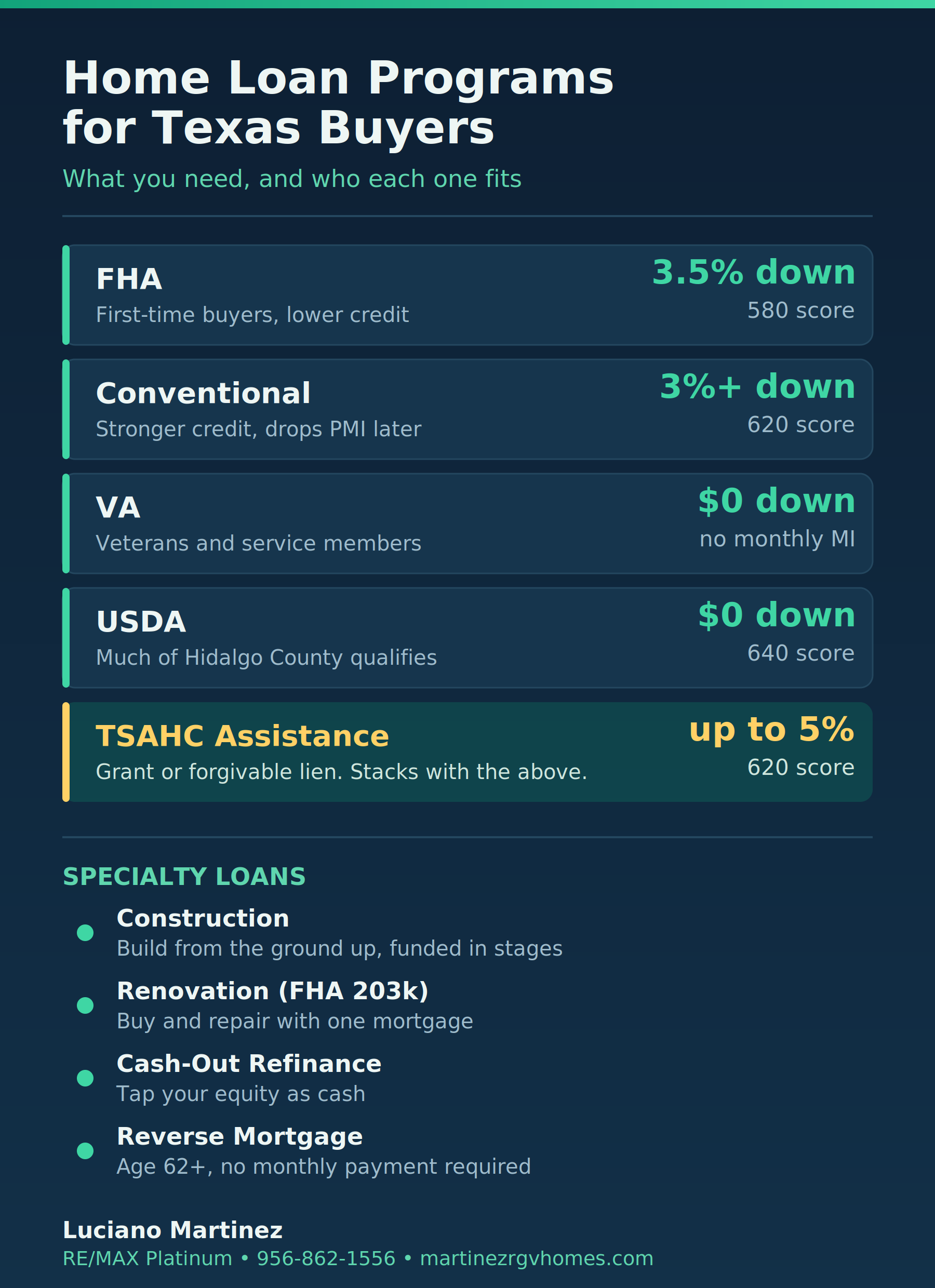
Here's the quick version before we go deeper:
- FHA: 3.5% down, 580 credit score. Best for first-time and lower-credit buyers.
- Conventional: 3% to 20% down, 620 credit score. Best for stronger credit.
- VA: $0 down for eligible veterans and service members.
- USDA: $0 down in eligible areas, around 640 credit score.
- Construction: for building a home from the ground up.
- Renovation: buy and repair a home with one loan.
- Cash-out refinance: for existing owners tapping equity.
- Reverse mortgage: for owners age 62 and up.
FHA loans: the first-time buyer workhorse
FHA is the loan most of my first-time buyers end up using, and for good reason. It has the most forgiving credit requirements of any standard program. You need a 580 credit score for 3.5% down, and if your score falls between 500 and 579 you can still qualify with 10% down.
On a $250,000 home, 3.5% down is $8,750. That's a number a lot of working families in the Valley can actually reach, especially with a little help from a down payment assistance program.
The tradeoff is mortgage insurance. If you put down less than 10%, FHA mortgage insurance stays for the life of the loan. Plenty of buyers refinance into a conventional loan a few years later once they've built equity and their credit has improved. That's a normal move, not a failure.
Best for: first-time buyers, buyers with credit in the 580 to 660 range, or anyone who needs a low down payment.
Conventional loans: better terms if your credit is strong
Conventional loans are not government-backed, so the rules are stricter. You need a 620 credit score minimum, and the best rates show up at 740 and above.
The big advantage is private mortgage insurance drops off automatically once you reach 20% equity. FHA insurance doesn't do that. So if your score is 680 or higher, a conventional loan often costs less per month over time even when the down payment is larger.
And you don't necessarily need 20% down. Programs like Fannie Mae HomeReady and Conventional 97 let qualified first-time buyers put down as little as 3%.
Best for: buyers with credit above 680, or anyone who wants to drop mortgage insurance eventually.
VA loans: the best deal in the business if you qualify
If you're an eligible veteran, active-duty service member, National Guard, Reserve member, or a surviving spouse, the VA loan is hard to beat. Zero down payment, no monthly mortgage insurance, and competitive rates.
There's no official minimum credit score set by the VA, though most lenders want to see 580 to 620. You'll pay a one-time VA funding fee, which can be rolled into the loan, and it's waived entirely for veterans with a service-connected disability rating.
Given how many veterans live in the Rio Grande Valley, this program gets used less than it should. If you served, ask your lender about it before you consider anything else.
Best for: any eligible veteran or service member. If you qualify, start here.
USDA loans: $0 down across much of Hidalgo County
This is the program most Valley buyers don't know about, and it's a big deal locally. USDA loans require zero down payment and typically want a credit score around 640. The catch is the home has to sit in a USDA-eligible area and your household income has to fall under the local limit.
Here's why that matters here: roughly 81.5% of Hidalgo County is USDA-eligible. Much of Mission, the outskirts of Edinburg, and towns like Alton, Palmview, and La Joya fall inside the eligible zone. The dense center of McAllen is excluded, but drive a few miles out and the map opens up.
I've had buyers keep their entire savings account intact because of this program. If you're open to buying slightly outside the McAllen core, it's worth checking the eligibility map before you assume you need a down payment.
Best for: buyers in rural and suburban RGV areas with moderate income and a 640-plus score.
TSAHC: Texas down payment assistance you can actually use
This one deserves more attention than it gets. The Texas State Affordable Housing Corporation runs two down payment assistance programs, and they're among the better ones in the country.
Homes for Texas Heroes serves public service workers: teachers, teacher aides, school librarians, school counselors, school nurses, police officers, correctional officers, firefighters, EMS personnel, and veterans.
Home Sweet Texas is open to any Texas buyer who meets the income and credit requirements, regardless of profession.
Both offer assistance of up to 5% of your loan amount toward your down payment and closing costs. You can take it as a grant you never repay, or as a forgivable second lien that clears after three years as long as you stay in the home. On a $250,000 loan, 5% is $12,500, which for many buyers is the difference between buying this year and waiting two more.
A few things worth knowing. You generally need a 620 credit score for government loans or 640 for conventional. Neither program requires you to be a first-time buyer, though first-time buyers can also add a Mortgage Credit Certificate worth up to $2,000 a year in federal tax credit. Income limits vary by county. And you apply through a participating lender, not directly to TSAHC. You'll also complete a short homebuyer education course before closing.
If you're a teacher or first responder in the Valley and you've been assuming homeownership is out of reach, this is the program to ask about.
Construction loans: building instead of buying
If you want to build rather than buy an existing home, a construction loan covers the build itself. These work differently from a standard mortgage. Funds get released in stages as construction hits milestones, and you typically pay interest only during the build.
Many Texas lenders offer a single-close construction-to-permanent loan, which converts to a regular mortgage when the home is finished so you only go through closing once. Down payment requirements are usually higher than a standard purchase, and credit requirements are stricter, since the lender is financing something that doesn't exist yet.
Best for: buyers with land, or those building custom in the growing areas around Edinburg and north McAllen.
Renovation loans: buy the fixer-upper and fix it with one loan
Here's a program that solves a real problem. You find a house at a good price, but it needs a roof, a kitchen, or serious repairs. A standard mortgage won't cover the repairs, and you don't have $40,000 in cash sitting around.
A renovation loan rolls the purchase price and the repair costs into a single mortgage. The FHA 203(k) is the best-known version, with conventional equivalents like Fannie Mae HomeStyle available too. The loan amount is based on what the home will be worth after the improvements, not what it's worth today.
There's more paperwork here, and the work usually has to be done by approved contractors on a set schedule. But for a buyer willing to take on a project, it opens up homes that other buyers have to skip.
Best for: buyers eyeing older homes in established McAllen neighborhoods that need updating.
Cash-out refinance and reverse mortgages: for current homeowners
These two aren't purchase loans, but they come up often enough to mention.
A cash-out refinance replaces your existing mortgage with a larger one and gives you the difference in cash. People use it for home improvements, paying off higher-interest debt, or major expenses. In Texas there are specific state rules on how much equity you can pull out of a primary residence, so ask your lender about Texas-specific limits.
A reverse mortgage lets homeowners 62 and older convert equity into cash with no monthly mortgage payment required. The loan comes due when the owner sells, moves out, or passes away. It can be a reasonable tool for some retirees, but it's a significant decision with real tradeoffs, so it deserves careful review with a lender and ideally a family conversation.
So what type of home loan is best for me?
Honestly, there's no chart that can answer that, and anyone who tells you otherwise is guessing. But here's roughly how I think about it:
- Served in the military? Ask about a VA loan first.
- Buying outside the McAllen core with moderate income? Check USDA eligibility.
- Credit in the 580 to 660 range? FHA is likely your path.
- Credit above 680 with some savings? Price conventional against FHA.
- Teacher, nurse, or first responder? Ask about TSAHC Homes for Texas Heroes.
- Short on down payment cash? Ask about TSAHC either way.
- Found a home that needs work? Ask about a renovation loan.
These programs also stack. A first-time buyer might use an FHA loan with TSAHC assistance covering the down payment and a Mortgage Credit Certificate reducing their taxes. That combination is what turns a "someday" into a closing date.
The only way to know what you actually qualify for is to talk to a lender who works with all of these programs. Your score, income, debt-to-income ratio, and job history get reviewed together, and different lenders have different overlays on top of the program minimums.
Frequently Asked Questions
What are the different types of home loans?
The main types are FHA loans (3.5% down, 580 credit score), conventional loans (620 minimum, 3% to 20% down), VA loans ($0 down for eligible veterans), and USDA loans ($0 down in eligible rural and suburban areas). There are also specialty loans including construction loans for building, renovation loans for fixer-uppers, cash-out refinances, and reverse mortgages for owners 62 and older.
What type of loan is best for first-time home buyers?
FHA is the most common choice because it allows a 580 credit score with 3.5% down. But if you're a veteran, a VA loan is usually better since it requires nothing down. And if you're buying in a USDA-eligible area, that program also offers $0 down. Texas first-time buyers should also ask about TSAHC down payment assistance, which can be layered on top of most of these.
How does a renovation loan work?
A renovation loan combines the home's purchase price and the cost of repairs into one mortgage. The loan amount is based on the home's projected value after improvements rather than its current condition. The FHA 203(k) is the most common version. Funds for the work are held and released as repairs are completed, usually by approved contractors.
What is an FHA 203(k) renovation loan?
It's an FHA-backed loan that lets you buy a home and finance repairs or improvements with a single mortgage. It's designed for homes that need work before they'd qualify for standard financing. It carries FHA's more flexible credit requirements, though it involves more documentation and contractor oversight than a standard FHA loan.
How do construction loans work in Texas?
A construction loan funds the building of a home in stages, releasing money as work reaches milestones, with interest-only payments during construction. Many Texas lenders offer single-close construction-to-permanent loans that convert into a standard mortgage when the home is finished, so you close once. Down payment and credit requirements are typically higher than for buying an existing home.
Can you get down payment assistance in Texas?
Yes. TSAHC offers up to 5% of your loan amount as a grant or forgivable second lien through its Homes for Texas Heroes and Home Sweet Texas programs. You generally need a 620 credit score, and income limits vary by county. Neither program requires you to be a first-time buyer. You apply through a participating lender rather than directly to TSAHC.
If you're buying in McAllen, Mission, Edinburg, or anywhere in the Rio Grande Valley and you're not sure which loan fits your situation, let's talk it through. I work with local lenders who handle all of these programs, including USDA and TSAHC assistance, and getting you matched to the right one is the part that saves you the most money. Reach me at 956-862-1556.