Every summer I get the same question from buyers, usually somewhere around the third showing: what's this house going to cost me to cool?
It's a fair question, and in the Valley it's a bigger deal than almost anywhere else in the country. Our air conditioners run something like nine months a year, and cooling is the single largest piece of most households' summer electric bill. The difference between an efficient home and an inefficient one here isn't a few dollars. It's real money, every month, for as long as you own the place.
The problem is that most energy-efficiency advice online is written for the whole country, which means it's written for climates nothing like ours. Some of the upgrades that get pushed hardest barely matter in South Texas, while the ones that matter most here get a single sentence. Here's what actually moves the needle on an electric bill in the Rio Grande Valley, and what to look for when you're touring homes.
Key Takeaways
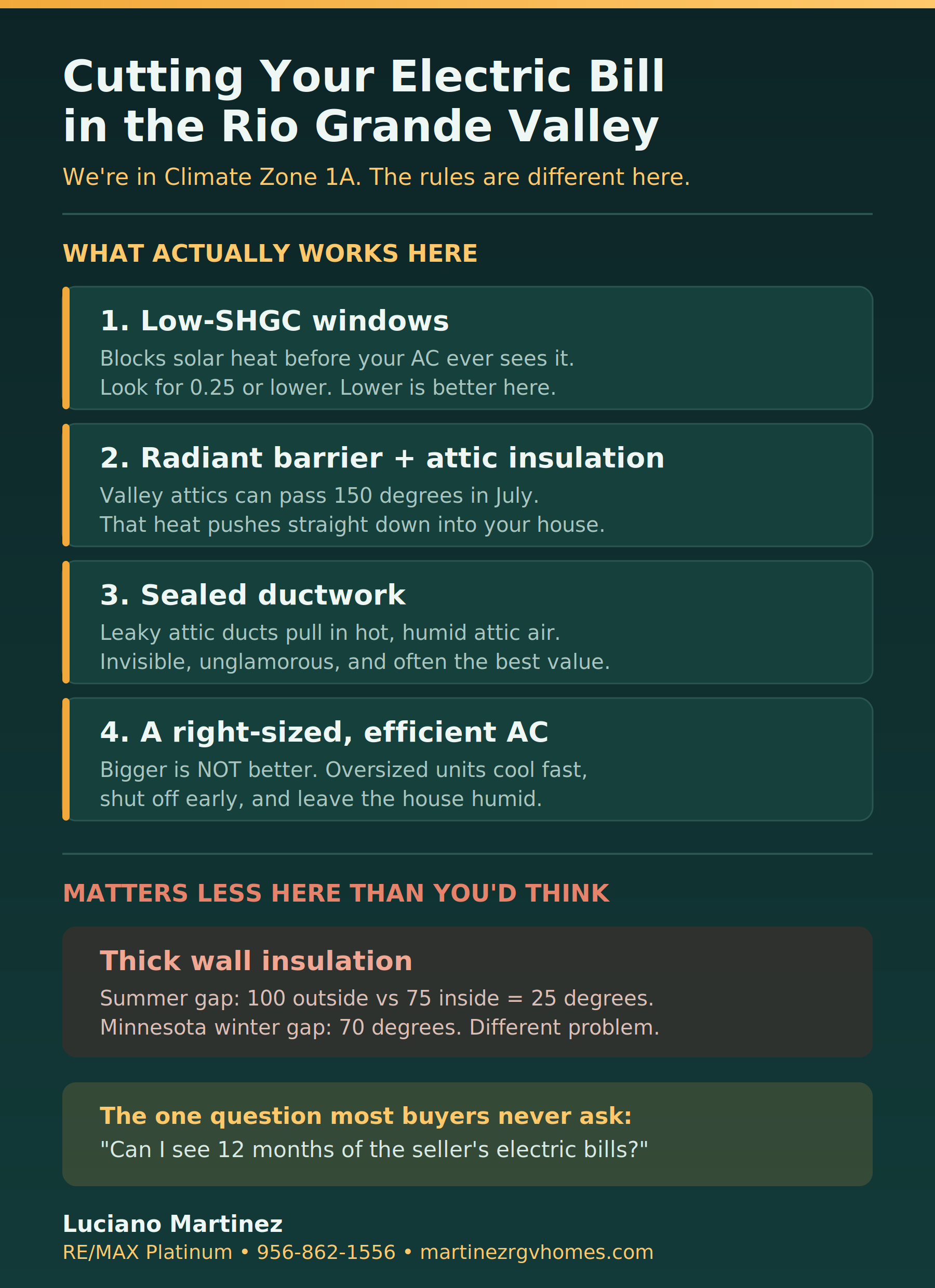
- We're in Climate Zone 1A: very hot and humid, which means keeping heat out matters far more than keeping heat in.
- Windows are the biggest lever: low solar heat gain glass blocks radiant heat before your AC ever has to deal with it.
- The attic is the second biggest: an unprotected RGV attic can exceed 150 degrees, and that heat pushes straight down into your living space.
- An oversized AC is not a better AC: units that are too large cool the air without pulling out humidity, leaving the house clammy.
- Thick wall insulation matters less here: it's a top upgrade in cold climates and a poor return in ours.
Why energy advice written for other states doesn't apply here
Building codes divide the country into climate zones, and the Rio Grande Valley sits in Zone 1A, the very hot and humid category. Almost nowhere else in the continental United States is in Zone 1.
That changes the math on everything. In Minnesota, the goal is trapping heat inside during a long, brutally cold winter, so thick insulation everywhere is the priority. Here, the goal is the opposite: block heat before it gets in, and pull moisture out of the air once it does. Humidity control is nearly as important as temperature control, because a house at 75 degrees with high humidity feels worse than a drier house at 78.
So when you read a national article recommending you pack your walls with insulation and pick windows that let in solar heat, understand that advice was written for someone living through a Chicago winter. It's not wrong. It's just not about your house.
1. Windows: the single biggest factor
If you only look at one thing, look at the windows.
The number that matters is Solar Heat Gain Coefficient (SHGC), which measures how much of the sun's radiant heat passes through the glass. Lower is better in our climate. Current code for Zone 1A calls for an SHGC of 0.25 or lower, meaning the glass blocks roughly three-quarters of the solar heat hitting it.
This is where our climate flips the national advice completely. In cold states, builders want a high SHGC so winter sun helps heat the house for free. Here, that same window turns your living room into a greenhouse from April through October and makes your AC fight the sun all afternoon.
When you're touring a home, look for a sticker or label still on the glass, or ask the seller's agent what the windows are. Older single-pane windows with no coating are the worst case, and west-facing rooms with large untreated windows will be noticeably hotter in the afternoon. That's something you can feel during a showing if you pay attention.
2. The attic: where the heat actually comes from
On a July afternoon in the Valley, an unprotected attic can climb past 150 degrees. That superheated air sits directly above your ceiling, and it pushes heat down into your living space all day and well into the evening.
Two things address it:
A radiant barrier is a reflective layer, usually foil-faced sheathing or a material installed against the underside of the roof deck. It reflects radiant heat back out instead of letting it soak into the attic. In a climate like ours it can drop attic temperatures substantially, which means less heat migrating into the house and less work for your AC.
Attic insulation is the other half. Code minimum for our zone is lower than in cold climates because heating loads here are almost irrelevant, but going above the minimum still pays off for cooling. Many builders and remodelers in the Valley install more than required for exactly that reason.
Some newer homes use spray foam applied to the roof deck, which brings the attic inside the conditioned envelope entirely. It costs more up front but it's very effective in hot-humid climates, and it solves the duct problem I'm about to describe.
3. Ducts: the leak nobody sees
This one is invisible and it's costing a lot of Valley homeowners real money.
In most RGV homes, the ductwork runs through the attic. When those ducts leak, two bad things happen at once. You lose cooled air you already paid to produce, and the system pulls in replacement air from a 150-degree, humid attic. You're effectively air conditioning your attic while your AC works overtime to cool air that keeps getting hotter.
Modern code requires ducts in unconditioned spaces to be insulated, and it requires a duct leakage test at construction. That's a meaningful upgrade over how homes were built twenty or thirty years ago, when duct sealing was often an afterthought.
If you're buying an older home, duct sealing is one of the better-value improvements you can make. It's not glamorous, nobody sees it, and it often delivers a bigger bill reduction than the upgrades people get excited about.
4. The AC itself: efficiency and, more importantly, size
Two things matter about the air conditioner, and most buyers only know about one of them.
The first is efficiency rating. Modern systems are rated in SEER2, and higher numbers mean less electricity for the same cooling. Given how many months a year our systems run, the gap between an old low-efficiency unit and a modern high-efficiency one adds up quickly. Variable-speed systems do especially well here because they run longer at lower output, which is exactly what removes humidity.
The second, and the one almost nobody asks about, is sizing. It seems logical that a bigger AC would be better in a hot climate. It isn't. An oversized unit cools the air to the thermostat setting fast, then shuts off before it has run long enough to pull moisture out. You get a house that's technically cool but feels damp and sticky, plus short-cycling that wears out the equipment and, in a humid climate, creates conditions for mold.
Proper sizing comes from a load calculation, which contractors call a Manual J. If you're buying new construction or replacing a system, that's a fair question to ask: was this sized with a load calculation, or did someone just pick a tonnage off a rule of thumb?
What matters less here than you'd think
Thick wall insulation is the big one.
In cold climates, heavy wall insulation is near the top of every efficiency list, and for good reason. When it's zero degrees outside and seventy inside, that's a seventy-degree gap driving heat out of your house through every surface.
Our summer gap is much smaller. When it's 100 outside and you're keeping the house at 75, that's a twenty-five degree difference. The same wall assembly is doing far less work here than it would in Minnesota in January, which is why standard wall insulation is generally adequate in our zone and why spending heavily to upgrade it gives you a weak return.
That money does more for you in the attic, the ducts, or the windows. It's not that wall insulation is useless. It's that it's rarely where your next dollar belongs in the Valley.
What to actually ask when you're touring a home
Here's a short list you can run on any showing:
- How old is the air conditioning system, and what's its efficiency rating?
- Are the windows double-pane with a low-E coating, and do you know the SHGC?
- Is there a radiant barrier in the attic?
- Have the ducts ever been sealed or tested?
- What do the summer electric bills actually run? Sellers can often provide twelve months of bills, and that's the most honest answer available.
That last one is worth pushing on. Every other item is a proxy for the real question, which is what this house costs to cool. Actual bills from the past year answer it directly.
New construction versus an older home
New builds around Edinburg, McAllen, and Mission are constructed to current energy code, which means they come with low-SHGC windows, tested ductwork, blower-door testing on the envelope, and better attic performance as standard. That's a genuine advantage, and it's not just marketing.
But it doesn't make the questions go away. Builders offer efficiency packages as upgrades, and it's worth knowing which ones matter in our climate and which are mostly sales material. A radiant barrier upgrade is worth considering here. A wall insulation upgrade usually isn't, for the reasons above.
An older home can be brought a long way with targeted work. Sealing ducts, adding attic insulation and a radiant barrier, and replacing an aging AC with a properly sized modern unit will change a home's cooling costs substantially, and those improvements usually cost far less than the price premium on a comparable new build.
A note on rebates and tax credits
This part has changed recently, and a lot of what's online is out of date.
The federal energy efficiency tax credits expired at the end of 2025. The Energy Efficient Home Improvement Credit and the Residential Clean Energy Credit were both terminated for equipment placed in service after December 31, 2025. If you see a blog or a contractor citing a 30% federal credit for a new heat pump or insulation, that information is stale.
Texas has been allocated substantial federal funding for its HOMES and HEAR rebate programs, but those programs have not launched yet. The state's energy office is still in the design phase and has publicly advised homeowners against entering into any agreements tied to these rebates until the programs formally launch and an approved contractor list exists. If a contractor promises you a state rebate today, be skeptical.
What does still exist are utility rebate programs. Depending on who provides your electricity, you may find incentives for high-efficiency HVAC, attic insulation, duct sealing, and smart thermostats. Magic Valley Electric Cooperative and AEP Texas both run programs, and the details change periodically, so check directly with your provider rather than relying on a third-party summary.
Frequently Asked Questions
What energy features actually lower electric bills in South Texas?
The biggest impact comes from blocking heat before it enters the house. Low solar heat gain windows, a radiant barrier and adequate insulation in the attic, sealed ductwork, and a properly sized high-efficiency air conditioner do the most in our climate. Cooling is the largest share of a summer electric bill here, so anything that reduces the load on your AC has an outsized effect.
What is SHGC and why does it matter in the Rio Grande Valley?
Solar Heat Gain Coefficient measures how much solar radiation passes through a window. In our climate zone, code calls for 0.25 or lower, meaning the glass blocks about three-quarters of the sun's heat. Lower is better here. In cold climates the preference is reversed, since solar heat helps warm the home in winter.
Is a radiant barrier worth it in South Texas?
It's one of the better-suited upgrades for our climate. Valley attics can exceed 150 degrees in summer, and a radiant barrier reflects that heat away instead of letting it soak into the attic and then into your living space. In cold climates it does very little, which is why national advice tends to skip it.
Does a bigger air conditioner cool a house better?
No, and in a humid climate an oversized system actively causes problems. It cools the air quickly, then shuts off before it has run long enough to dehumidify. The result is a house that's cool but feels damp, along with short-cycling that shortens equipment life. Correct sizing comes from a load calculation, not from guessing bigger is safer.
Are there still tax credits for energy-efficient home upgrades?
Not at the federal level. The Energy Efficient Home Improvement Credit and Residential Clean Energy Credit both expired for property placed in service after December 31, 2025. Texas HOMES and HEAR rebate programs have been funded but have not launched. Utility rebates through providers like Magic Valley Electric Cooperative and AEP Texas remain available, so check with your provider for current offerings.
If you're house hunting in McAllen, Mission, or Edinburg and you want to know what a particular home is really going to cost you to cool, ask me to request the seller's utility history. It's one of the most useful pieces of information in a purchase and almost nobody asks for it. Reach me at 956-862-1556.