


If you follow Texas real estate news, you've seen the headlines. Austin prices falling. Dallas cooling. Inventory piling up across the state's biggest metros. A lot of people in the Valley read those stories and assume the same thing is happening here.
It isn't, exactly. Our market is genuinely different from the big metros, but not always in the way people assume, and the honest version of that comparison is more useful than the hype version. Here's how the Rio Grande Valley actually stacks up against Austin, Dallas, and the rest of Texas right now, using real numbers.
Key Takeaways
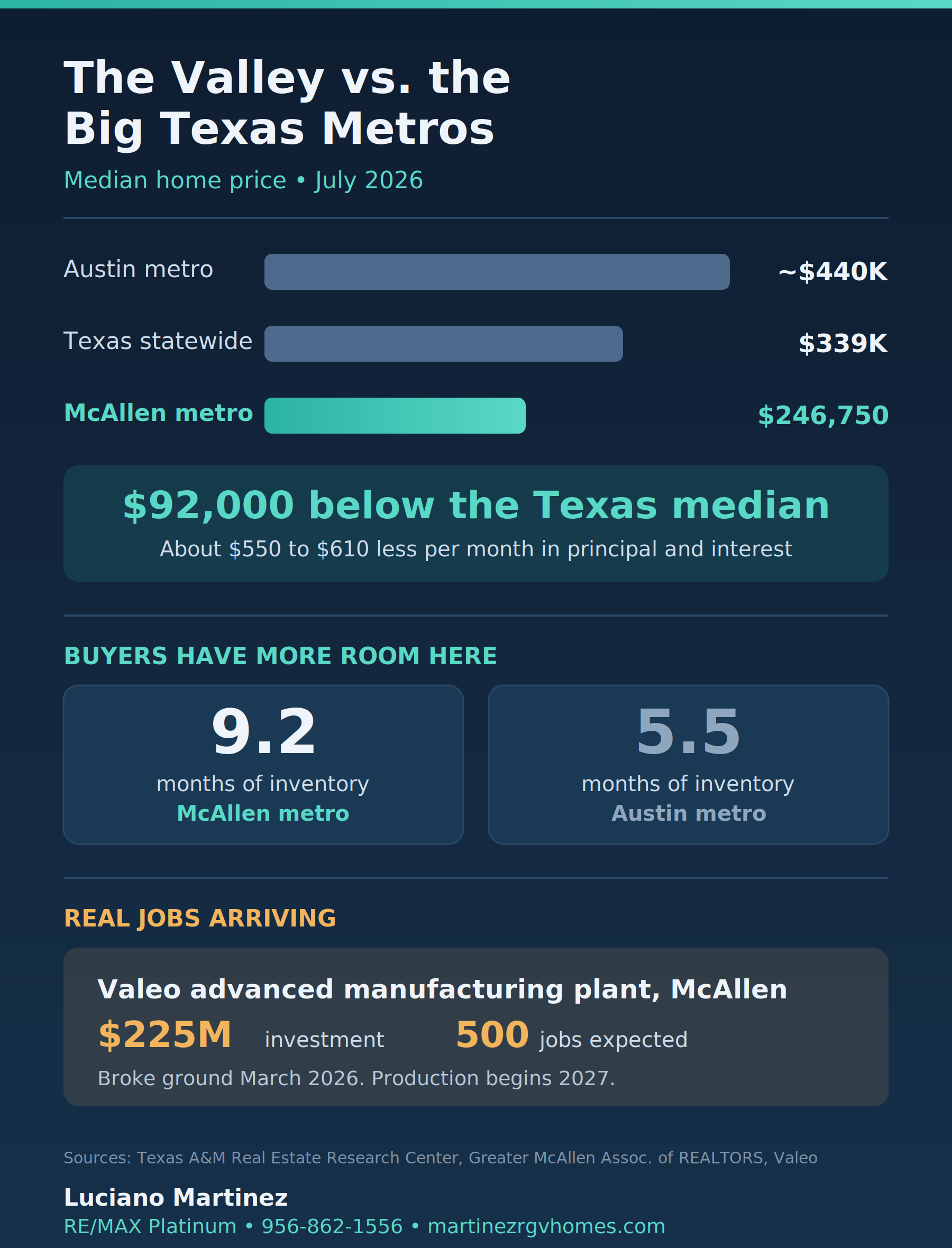
- The Valley is far more affordable: our metro median of $246,750 is about $92,000 below the Texas median and nearly $200,000 below Austin.
- This year, prices are moving with the state: the Valley was down 1.3% year over year in July, close to Austin's 1.4% decline.
- The difference is the longer story: Austin has fallen roughly 24.5% from its 2022 peak. The Valley never ran up like that.
- Real job investment is arriving: Valeo is building a $225 million plant in McAllen expected to create up to 500 jobs.
- Valley buyers have more leverage than most of Texas: 9.2 months of inventory here versus about 5.5 months in Austin.
How does the RGV housing market compare to Austin and Dallas?
The Rio Grande Valley is significantly cheaper than the major Texas metros, and it avoided the boom-and-bust cycle that hit Austin hardest. Year over year in 2026, though, prices across Texas are moving in a similar direction: roughly flat to slightly down nearly everywhere.
Here's the side-by-side for July 2026:
- McAllen-Edinburg-Mission metro: median $246,750, down 1.3% year over year
- Texas statewide: median $339,000, down 0.2% year over year
- Austin metro: median near $440,000, down 1.4% year over year
Statewide and Austin figures come from the Texas A&M Real Estate Research Center. Valley figures come from the Greater McAllen Association of REALTORS.
The real story is the affordability gap
Forget the percentage changes for a moment and look at the actual prices.
A typical home in the McAllen area sells for about $92,000 less than the typical home in Texas. Compared to Austin, the gap is close to $195,000.
To put that in monthly terms, financing $92,000 less on a 30-year loan at 6% to 7% works out to roughly $550 to $610 less in principal and interest every month, before you even count lower property taxes on a lower assessed value. For a lot of families, that's the difference between owning and renting.
That gap is what keeps drawing people to the Valley. Remote workers, retirees, and families from higher-cost parts of Texas can buy a full single-family home here for what a much smaller place costs in the big metros.
Why Austin's story is so different from ours
The headlines about Austin are real, but they're describing a specific situation that didn't happen here.
Austin went through an enormous run-up during the pandemic, when remote workers and tech money flooded in and builders raced to keep up. Prices peaked around May 2022 at roughly $550,000. Then rates rose, demand cooled, and builders had overbuilt. Austin has since dropped about 24.5% from that peak, the steepest decline of any major Texas metro.
The Valley didn't have that kind of speculative spike, so it hasn't had that kind of fall. Our prices move in smaller steps in both directions. That's less exciting during a boom, but it's a lot more comfortable when the market turns.
I want to be straight about one thing, though. That doesn't mean the Valley is immune to what's happening across Texas. This year our prices are down about the same as Austin's on a year-over-year basis. The difference isn't that we're beating the big metros right now. It's that we're starting from a far more affordable place and we didn't have as far to fall.
What's actually driving demand in the Valley
Stable housing demand needs jobs underneath it, and the biggest local development this year is a real one.
In March 2026, French automotive technology company Valeo broke ground on a $225 million, 337,000-square-foot manufacturing plant in McAllen, at Ware Road and Idela Avenue in the McAllen Nearshoring Industrial Park. The plant will produce central computing systems for General Motors' next generation of vehicles, and it's expected to create up to 500 specialized jobs in engineering, technical, and advanced manufacturing roles. Production is scheduled to begin in 2027.
Valeo is partnering with UTRGV and South Texas College on workforce training, which means some of those jobs are meant to go to people who already live here. Local economic development officials have described it as the largest industrial investment the region has ever seen.
Five hundred jobs won't transform a metro of nearly a million people overnight. But skilled manufacturing jobs bring higher wages, those wages support homeownership, and the investment signals that more companies are looking at the Valley for nearshoring. That's the kind of demand that holds a housing market steady over years, not months.
Valley buyers have more leverage than most of Texas
Here's the part that surprised me when I lined up the numbers.
The McAllen-Edinburg-Mission metro is carrying about 9.2 months of inventory. Austin, despite all its headlines about a buyer's market, is sitting closer to 5.5 months. A balanced market runs around six.
That means buyers in the Valley actually have more selection and more negotiating room than buyers in Austin right now. You're not competing with multiple offers. You can take your time, use your full option period, and negotiate on overpriced listings.
So the Valley gives you two advantages at once: much lower prices, and more leverage once you're shopping. That combination is unusual.
What this means if you're buying
You're shopping in one of the most affordable markets in Texas, with more inventory than most of the state, and with real job investment arriving. That's a strong position.
Two cautions. First, don't wait for a crash. Valley prices didn't spike, so they're not set up for a big drop. The advantage right now is selection and negotiating room, not a falling market. Second, inventory is high partly because a lot of homes are overpriced. Your leverage is real, but it's strongest on homes that have been sitting, not on well-priced homes that just listed.
What this means if you're selling
Price to today's comparable sales, not to what Austin headlines suggest or what a neighbor got in 2022. With 9.2 months of inventory, buyers have plenty of alternatives, and an overpriced home simply sits.
The upside for Valley sellers is that you're not facing an Austin-style correction. Values here are holding close to last year. Sellers who price accurately are still getting close to full asking. The ones who struggle are the ones who price on hope instead of data.
Frequently Asked Questions
Is the Rio Grande Valley housing market crashing?
No. The McAllen-Edinburg-Mission metro median was down 1.3% year over year in July 2026, which is in line with modest declines across most of Texas. The Valley did not experience the large pandemic-era price spike that cities like Austin did, so it hasn't seen a comparable decline.
How much cheaper is the Rio Grande Valley than Austin?
Significantly. The McAllen metro median was $246,750 in July 2026, compared with an Austin metro median near $440,000. That's a gap of roughly $195,000. The Valley median is also about $92,000 below the Texas statewide median of $339,000.
Are home prices falling in Texas in 2026?
Slightly. According to the Texas A&M Real Estate Research Center, statewide prices were down 0.2% year over year in July 2026, with a median of $339,000. Austin was down 1.4%. The declines have been easing as the year has gone on.
Is it a buyer's market in the RGV?
Yes. The McAllen-Edinburg-Mission metro has about 9.2 months of inventory, well above the roughly six months that marks a balanced market. That's also more inventory than Austin, which sits closer to 5.5 months, so Valley buyers currently have more selection and negotiating room.
What is the Valeo plant in McAllen?
Valeo, a French automotive technology company, broke ground in March 2026 on a $225 million, 337,000-square-foot manufacturing facility in McAllen. It will produce central computing systems for General Motors and is expected to create up to 500 specialized jobs, with production beginning in 2027.
Moving to the Valley for work, whether that's the new Valeo plant or anywhere else? Tell me where you'll be working and I'll show you which neighborhoods keep your commute reasonable and fit your budget. It's the fastest way to narrow down three cities and dozens of subdivisions. Call or text 956-862-1556.