


Every election year I get the same question from buyers: "Should we wait until after the election?" With the midterms on November 3, 2026 and early voting in Hidalgo County running October 19 to October 30, I am hearing it again.
The short answer is that elections affect the real estate market a lot less than people think. The national data shows a small pause in November, then the market picks right back up. What actually moves your monthly payment is mortgage rates, and the local races and bond votes that set your property tax bill. Here is what the numbers say, and what it means if you are buying or selling in McAllen, Mission, or Edinburg this fall.
Key Takeaways
- Elections cause a short pause, not a crash: November home sales usually dip a little in election years, then bounce back in December.
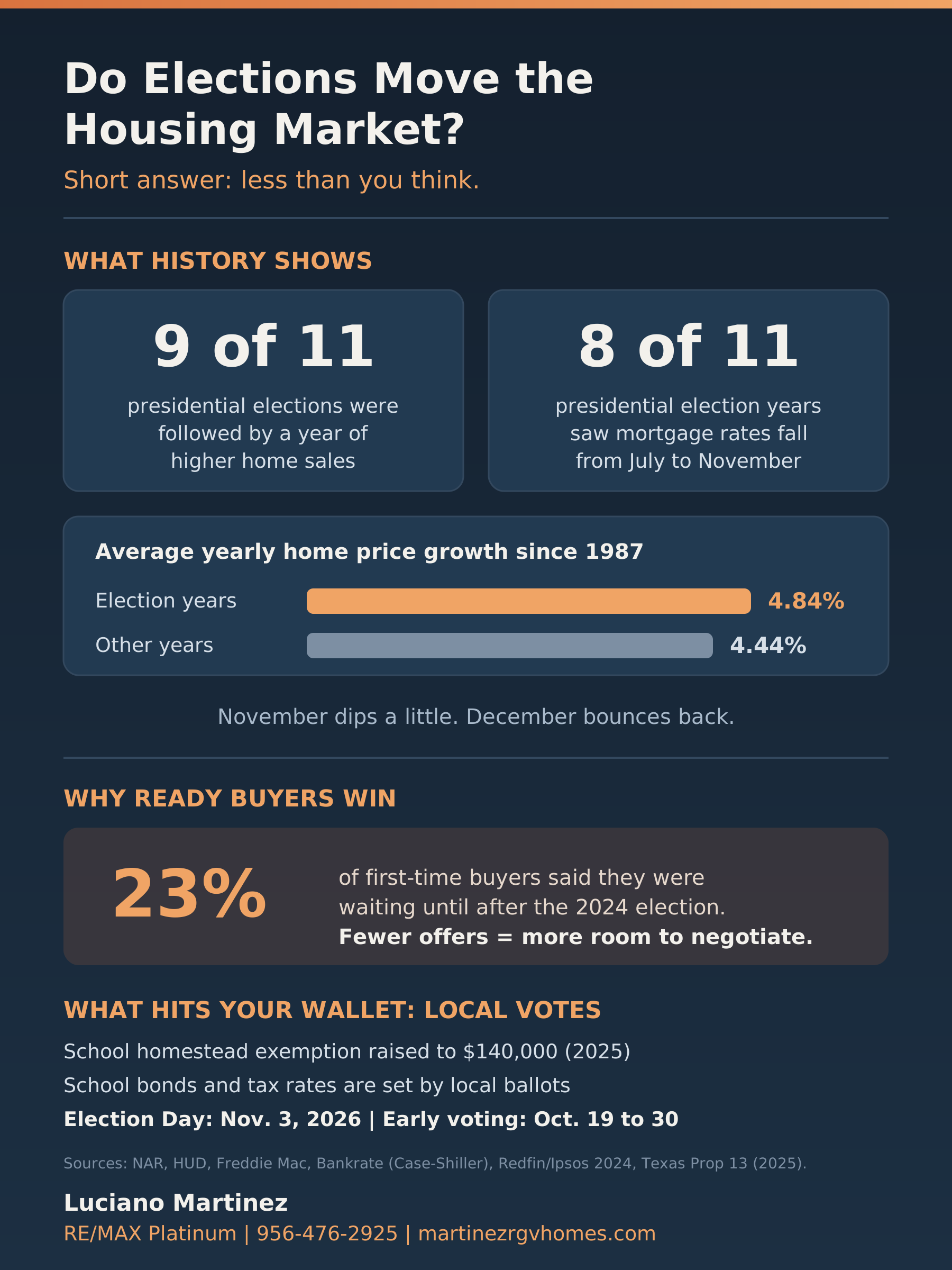
- Sales and prices keep rising after elections: home sales went up the year after 9 of the last 11 presidential elections.
- Many first-time buyers wait: in 2024, 23% of first-time buyers told Redfin they were holding off until after the election.
- Waiting buyers mean less competition: if you are ready now, the weeks around an election are a good time to negotiate.
- Local elections hit your wallet harder: school bonds, tax rates, and homestead exemptions change what you pay every month.
How do elections affect the real estate market?
Elections affect the real estate market mostly through buyer and seller nerves. Some people wait to see who wins, so home sales slow a little in the weeks before and after Election Day. Once the results are in, those buyers come back. Home prices and long-term demand depend on jobs, mortgage rates, and inventory, not on which party wins.
That is the whole story in one paragraph. The rest of this post shows the data behind it.
What the national data shows
Most of the research looks at presidential elections, because those get the most attention. Midterms usually have an even smaller effect. Here is what the numbers say:
- Sales: Home sales rose the year after 9 of the last 11 presidential elections, based on National Association of Realtors and HUD data.
- The November dip: Zonda chief economist Ali Wolf has noted that November is usually slower in election years. Sales then bounce back in December and keep rising into the next year.
- Prices: Bankrate looked at Case-Shiller data back to 1987. Prices rose an average of 4.84% in election years, compared with 4.44% in other years.
- The one bad year: 2008 was the only election year in that stretch where prices dropped hard, and that was the financial crisis, not the election.
- Mortgage rates: Freddie Mac data shows rates fell from July to November in 8 of the last 11 presidential election years.
Put plainly: the housing market cares about the economy. The election is noise on top of it.
Why some buyers wait, and why that can help you
In September 2024, Redfin and Ipsos surveyed people planning to buy their first home within a year. 23% said they were waiting until after the election. Many were waiting to see if a new housing plan would pass. Others were waiting for rate cuts or for down payment help programs.
I work with a lot of first-time buyers, so I understand the instinct. A home is the biggest purchase most people make, and uncertainty feels like a reason to sit still.
But think about what that means for the buyers who do not wait. If nearly a quarter of first-time buyers step back for a few weeks, there are fewer offers on the same homes. Sellers who need to move still need to move. That gives you more room to ask for closing costs, repairs, or a better price.
The RGV is already a buyer's market. In July 2026, Mission had about 9.1 months of inventory, according to the Greater McAllen Association of REALTORS. Anything over six months favors buyers. Add a pre-election pause on top of that, and a ready buyer has real leverage.
What actually moves your monthly payment
Two things matter far more than who wins in November.
1. Mortgage rates. Rates follow inflation, the bond market, and the Federal Reserve. Policy changes can affect those over time, but a single election night does not reset your rate. A half-point change in your rate does more to your payment than any campaign promise will this year.
2. Property taxes. In Texas there is no state income tax, so property taxes do a lot of the work. Your bill depends on the tax rates set by your city, county, school district, and other local entities. Many of those are decided by local elections.
If you are buying, look at the total monthly payment, including taxes and insurance, not just the price. Here is how to break down your monthly mortgage payment before you start shopping.
Local elections that hit RGV homeowners directly
If you want to know how elections affect your home, look at the bottom of the ballot, not the top. Three recent examples from the Valley:
- The 2025 homestead exemption vote: In November 2025, Texas voters approved raising the school district homestead exemption from $100,000 to $140,000. Homeowners 65 and older or with a disability can now exempt up to $200,000. That lowers the taxable value of your home for school taxes.
- McAllen ISD's 2026 bond: In May 2026, McAllen ISD voters approved a $335 million bond for roofs, air conditioning, and new classroom wings. The district said the tax rate would stay at 93 cents.
- Sharyland ISD's 2026 bond: The same day, voters in Sharyland ISD rejected all three parts of a $250 million bond, with about 61% voting no on the main proposition.
Those votes show up in tax bills, school buildings, and what buyers look for when they shop. On November 3, several local entities in Hidalgo County are holding their own elections, including the City of Mission, Edinburg CISD, and PSJA ISD. Check the Hidalgo County Elections Department website for your sample ballot so you know what is on it.
One thing every buyer should do: file your homestead exemption with the Hidalgo County Appraisal District once you move in. It is free, and with the higher exemption it saves more than it used to. My Texas homestead exemption guide walks through it.
Should you buy or sell before or after the election?
Make the decision based on your own timeline, not the election calendar.
If you are buying: If your credit, savings, and job are ready, the weeks around an election are a good time to shop. Fewer buyers, more inventory, and sellers willing to help with costs is a good mix. If you are not ready yet, use the time to get pre-approved and save, so you can move when the right home shows up.
If you are selling: Expect a few slower weeks in late October and November. Price the home right from day one, and be ready to offer help with closing costs, which is common in our market right now. Serious buyers are still out there. They are just more careful.
Want to see what has been sitting? Browse current homes for sale in McAllen, Mission, or Edinburg. Homes that have been listed for 60 days or more are where the best deals usually are.
Frequently Asked Questions
Do home prices go down during an election year?
Usually not. A Bankrate analysis of Case-Shiller data found home prices rose an average of 4.84% in election years since 1987, slightly more than in non-election years. The only big drop was 2008, which was caused by the financial crisis.
Should I wait until after the election to buy a house?
Only if your own finances are not ready. Historically, sales dip a little in November and bounce back after. Buyers who are ready to buy often face less competition in the weeks around an election.
Do midterm elections affect the housing market?
Midterms have even less effect than presidential elections. Most of what moves the market, like mortgage rates, jobs, and inventory, has nothing to do with Election Day. Local results, like school bonds and tax rate votes, matter more to your monthly payment.
Do mortgage rates change after an election?
Rates follow inflation, the bond market, and the Federal Reserve, not election results. Freddie Mac data shows rates fell from July to November in 8 of the last 11 presidential election years. A single election night does not set your rate.
How do local elections affect my property taxes in Hidalgo County?
Cities, school districts, and other local entities set tax rates and ask voters to approve bonds. Those decisions change your yearly tax bill. In 2025, Texas voters also raised the school homestead exemption to $140,000, which lowers school taxes for homeowners who file.
Not sure whether to move now or wait until spring? Send me your timeline and budget, and I will show you what is sitting on the market and what sellers in that range are offering. Call or text 956-476-2925.
Sources: National Association of Realtors, HUD, Freddie Mac, Bankrate, Redfin, Greater McAllen Association of REALTORS, KRGV, Hidalgo County Elections Department.